LangChain vs LlamaIndex: which framework should you build on?
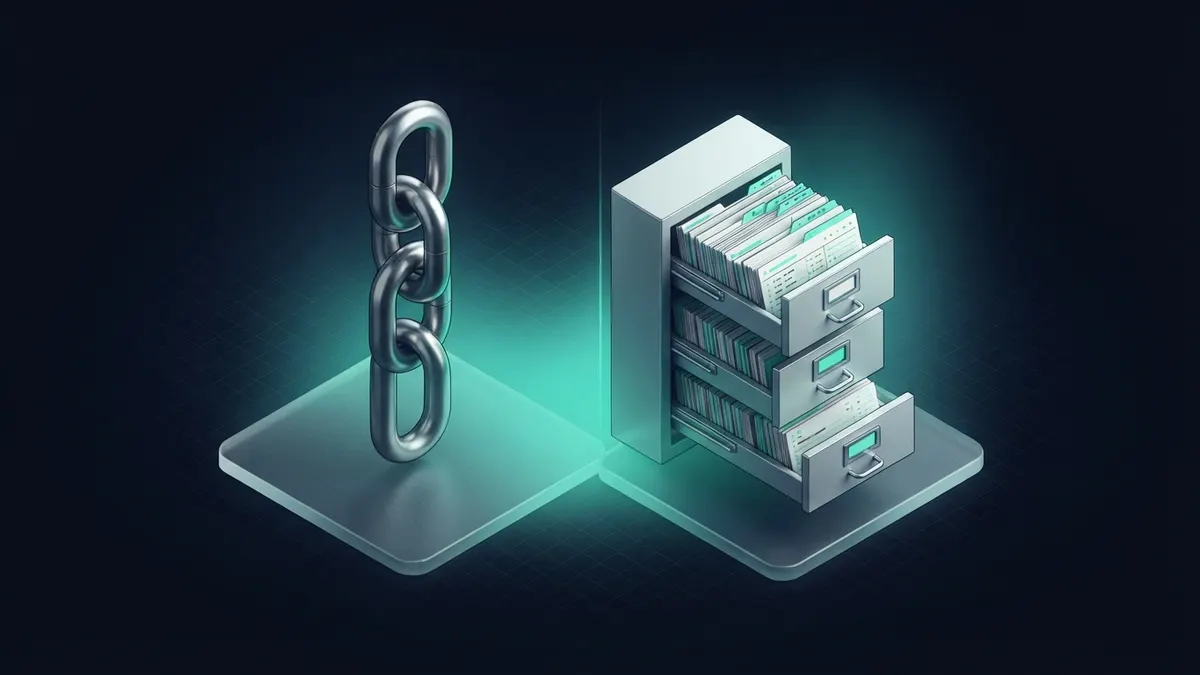
Choose LlamaIndex when your app is mostly about ingesting, indexing and querying your own data; choose LangChain, usually with LangGraph, when you need broad integrations and orchestration of tools and agents. Both are MIT-licensed Python and TypeScript frameworks, and many teams use them together.
What are LangChain and LlamaIndex?
LangChain is a general framework for building LLM applications. It offers a common interface over models, prompts, tools, retrievers and memory, plus a very large catalogue of integrations with model providers, vector stores and services.
LlamaIndex started as a data framework for LLMs. Its centre of gravity is getting your data in: loaders for many sources, parsing and chunking, index structures, retrievers and query engines that turn documents into grounded answers.
Both have grown toward each other. LangChain has solid retrieval building blocks, and LlamaIndex has agents and event-driven workflows. The difference today is emphasis and style more than raw capability.
So the real question is not which framework can do RAG or agents, since both can. It is which one makes your hardest problem easiest to express, debug and change six months from now, when the prototype has turned into something people rely on.
That framing matters because switching frameworks later is costly. Prompts, retrieval settings, tests and tracing all grow around the abstractions you pick, and they rarely port over cleanly.
How do they compare side by side?
| LangChain | LlamaIndex | |
|---|---|---|
| Licence | MIT | MIT |
| Languages | Python and JavaScript/TypeScript | Python and TypeScript |
| Core focus | Composing models, tools and chains; broad integrations | Data ingestion, indexing and retrieval for RAG |
| Agent orchestration | LangGraph for stateful, graph-based agents | Agents and Workflows (event-driven steps) |
| Observability | LangSmith (commercial) or open tools via callbacks | Integrations with open and commercial tracing tools |
| Document parsing | Many loaders; parsing often via third-party tools | Many loaders plus its own parsing ecosystem |
| Best for | Tool-heavy apps and agents across many services | Knowledge assistants and RAG over complex documents |
| Trade-off | Many abstractions to learn; API churn over time | Less natural fit for non-retrieval workflows |
Where does LlamaIndex win?
If the hard part of your product is the data, LlamaIndex tends to feel more direct. Its concepts map closely onto the RAG pipeline: documents, nodes, indexes, retrievers, rerankers and response synthesizers.
Advanced retrieval patterns such as hierarchical chunking, recursive retrieval, metadata filtering and sub-question decomposition are first-class ideas rather than recipes you assemble yourself.
It is a strong choice for internal knowledge bases, document question answering over PDFs and reports, and any product where retrieval quality is the main lever on answer quality.
It also encourages evaluation of retrieval itself. Checking whether the right passages came back, separately from whether the final answer sounds good, is the habit that most improves RAG systems, and LlamaIndex’s structure makes that separation natural.
Where it feels less natural is general automation that has little to do with documents, such as a workflow that moves data between SaaS tools. You can build it, but you are not using the framework’s strengths.
Where does LangChain win?
LangChain is strongest when your app touches many things: several model providers, search APIs, databases, business tools and custom functions. Its integration catalogue means someone has usually written the adapter you need.
For agents, the ecosystem’s answer is LangGraph, which models an agent as an explicit graph of steps with state, checkpoints and human approval points. That explicitness is valuable once agents move beyond demos.
It also has the largest pool of tutorials, examples and community answers, which lowers the cost of getting unstuck.
The flip side of that breadth is surface area. There are often several ways to do the same thing, and older tutorials may use patterns that have since been deprecated. Treat any example older than a release or two with suspicion and check it against current docs.
For teams that need tracing and evaluation, the ecosystem’s commercial LangSmith product is tightly integrated, while open-source tracing tools also plug in. That choice is separate from the framework licence, which stays MIT either way.
What does the developer experience feel like?
LangChain code is built around runnables that you pipe together, and the expression language makes short pipelines compact. The downside is indirection: when something fails deep in a chain, you may need tracing to see which prompt actually reached the model.
LlamaIndex offers high-level one-liners that build an index and a query engine from a folder of files, then lets you peel back layers as you customise. Beginners get results fast; experts eventually replace defaults with explicit components.
Both projects evolve quickly and have reorganised packages over time. Pin versions, read changelogs before upgrading, and keep framework-specific code in a thin layer of your application.
Cost of running is similar for both: the frameworks are free, and your bill comes from model calls, embeddings and the vector store. What differs is how many hidden calls a default pipeline makes, such as query rewriting or reranking, so read traces before you scale traffic.
Can you use both together?
Yes, and it is common. A frequent pattern is LlamaIndex for ingestion and retrieval, exposed as a tool or retriever, while LangGraph or another orchestrator drives the agent loop that decides when to call it.
Because both speak standard model APIs and vector stores, they can share an index in Qdrant, pgvector or another database. The glue is usually a small function that returns retrieved passages with their sources.
Mixing frameworks does double your dependency surface, so do it deliberately. If one framework covers ninety percent of your needs, write the remaining ten percent by hand instead of importing a second stack.
A clean boundary helps. Let retrieval return plain data, such as text, scores and source identifiers, rather than framework objects. Then the orchestrator never depends on the retrieval library’s internal types, and either side can be replaced.
Which should you choose?
- Document Q&A, internal knowledge search or RAG over messy files: LlamaIndex.
- An agent that calls many tools and APIs, with approval steps and long-running state: LangChain with LangGraph.
- A product mixing heavy retrieval with complex orchestration: LlamaIndex for retrieval, LangGraph for control flow.
- A small app with one model and one prompt: possibly neither; the provider SDK may be simpler.
- A TypeScript-first team: both have JS/TS packages, but check that the specific integrations you need exist in that language.
How to decide in an afternoon
Keep the test honest by using the same model, the same documents and the same questions in both builds. Differences in model choice swamp differences in framework, and you want to measure the framework.
Also note how much code you wrote to get each slice working. Less code is good, but only if you can still explain what happens at each step when an answer goes wrong.
- Write down your three hardest requirements, for example parsing scanned PDFs, calling a CRM, or resuming a paused agent.
- Build the smallest slice of each requirement in both frameworks, using your own data.
- Turn on tracing and inspect the exact prompts sent to the model.
- Pick the one whose failure modes you understood faster, not the one whose demo looked nicer.
Common mistakes
RepoLoot’s catalog tags starter projects by framework and difficulty, which helps you find working reference code for either choice.
- Adopting a framework for a problem the provider SDK already solves in twenty lines.
- Letting framework objects leak through your whole codebase, which makes upgrades painful.
- Accepting default chunking and retrieval settings without evaluating answers on real questions.
- Upgrading major versions without pinning, then chasing moved imports in production.
- Skipping observability, so nobody can explain why an answer was wrong.
Frequently asked questions
- Is LlamaIndex only for RAG?
- No. RAG is its strongest area, but LlamaIndex also offers agents and an event-driven Workflows system for multi-step applications. Many teams still pick it mainly for ingestion and retrieval, and pair it with another orchestrator when the control flow gets complicated.
- Do I need LangSmith to use LangChain?
- No. LangSmith is a separate commercial observability and evaluation product from the LangChain company. LangChain works without it, and open-source tracing tools such as Langfuse integrate through callbacks or OpenTelemetry-style instrumentation.
- Which is better for beginners?
- For a first RAG app over your own files, LlamaIndex usually gets you to a working answer with less code. For learning general LLM app patterns with the most tutorials available, LangChain has the larger community. Either way, learn the underlying model API too.
- Are these frameworks production-ready?
- Both are used in production, but production readiness depends on you: pinned versions, tests on real questions, tracing, timeouts and fallbacks. Keep framework code isolated so you can replace a component when it no longer fits.